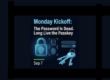
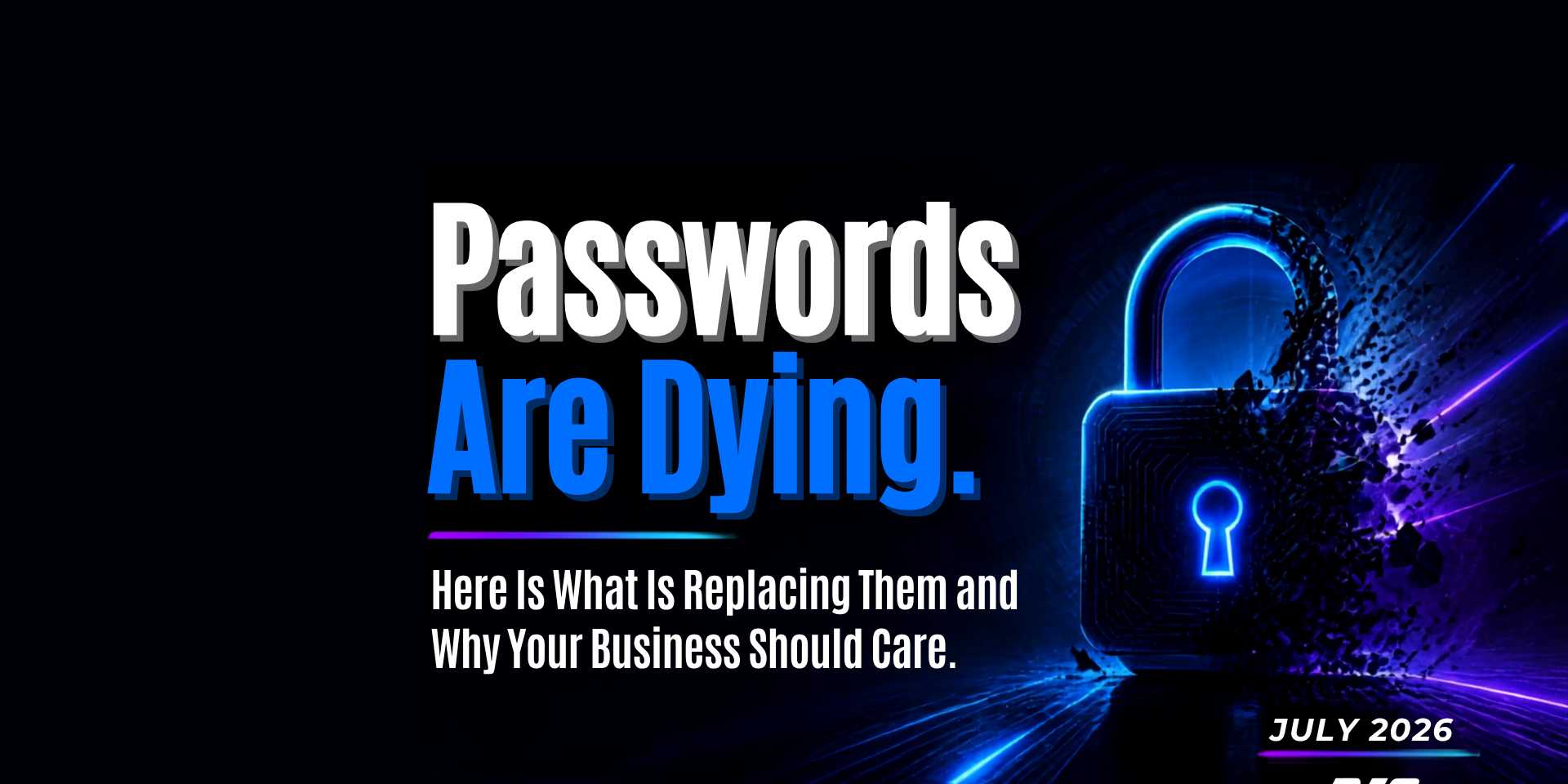
Happy Tuesday! Let us talk about something your employees deal with dozens of times every day, something that quietly drives IT teams absolutely crazy, and something that the entire technology industry is actively trying to retire: the password.
The Password Problem Is Worse Than You Realize
Passwords have been the primary mechanism for securing digital accounts since the earliest days of computing. They are also one of the weakest links in modern business security, and that gap between their prevalence and their effectiveness is a problem that gets harder to ignore every year.
Here is what we know about how passwords actually get used in business environments. Employees reuse passwords across multiple platforms. They choose passwords that are easy to remember, which means they are often easy to guess. They write them down, share them with colleagues when covering for each other, and resist changing them because the friction of resetting credentials interrupts their workflow. When forced to create complex passwords, they find workarounds: adding a number at the end, capitalizing the first letter, appending an exclamation point.
Attackers know all of this. Credential stuffing attacks, where criminals use stolen username and password combinations from previous breaches to attempt logins on other platforms, are automated and run at massive scale. A database of leaked credentials from one service is tested against banking platforms, HR portals, and business email systems within hours of a breach becoming known.
The result: stolen or weak credentials are now the leading cause of data breaches across all business sizes.
What Passwordless Authentication Actually Means
The industry has been working toward a post-password world for years, and in 2026 the technology is finally mature enough for mainstream business adoption. Passwordless authentication replaces the traditional username-and-password combination with something fundamentally more secure.
Passkeys are a leading standard, backed by Apple, Google, Microsoft, and the FIDO Alliance. Rather than a password stored on a server that can be stolen, a passkey uses a cryptographic key pair: a private key that stays on the user’s device and never leaves it, and a public key that the service uses to verify identity. Authentication happens through a biometric check, like Face ID or fingerprint, or through a device PIN. There is nothing to phish. There is nothing to steal from a server database. If a company’s authentication system is breached, the passkeys stored there are mathematically useless to an attacker without the private key on the user’s device.
Biometric authentication has become standard on mobile devices and is increasingly common on business laptops. Facial recognition, fingerprint scanners, and behavioral biometrics, which analyze typing patterns and mouse movement to verify identity continuously, are all part of a growing toolkit for eliminating password dependency.
Identity and Access Management (IAM) platforms now offer adaptive authentication that evaluates the context of a login attempt in real time. Is the user logging in from their normal device? From a recognized location? At their typical working hours? A login that matches established patterns flows smoothly. One that deviates triggers additional verification. The user experience for legitimate access is nearly frictionless while attackers face escalating barriers.
Why 2026 Is the Inflection Point
The passwordless movement crossed a meaningful threshold in 2026. Cloud deployment models now command 60 percent of the enterprise password management market, and major platforms are making passwordless the default experience rather than an opt-in feature. Identity and Access Management has moved from a back-office IT concern to a boardroom conversation.
Insurance carriers writing cyber liability policies are increasingly asking about MFA and passwordless adoption as part of their underwriting process. Businesses that cannot demonstrate strong identity security are facing higher premiums and reduced coverage. The financial incentive, layered on top of the security benefit, is accelerating adoption across industries.
For businesses still relying on passwords as their primary authentication method, the transition does not have to happen overnight. The practical starting point is implementing MFA on every account that supports it, then migrating high-risk systems like email, financial platforms, and remote access tools to passkey or biometric authentication as those capabilities become available.
The Human Side of the Transition
One of the persistent hesitations around passwordless adoption is user experience. Employees are familiar with passwords even if they dislike them, and there is natural resistance to change. The good news is that once deployed properly, passwordless authentication is almost universally embraced by users because it is simply faster and less frustrating. Unlocking your laptop with your fingerprint to get instant access to everything you need is a meaningfully better experience than typing three different passwords and waiting for MFA codes to arrive by text message.
The key is a thoughtful rollout: communicating what is changing and why, providing hands-on training during the transition, and having a clear support path for employees who run into issues. Done well, passwordless adoption tends to reduce IT help desk tickets related to password resets, which in enterprise environments can account for 20 to 50 percent of all help desk volume.
This Is Where RJ2 Technologies Comes In
Moving toward passwordless authentication and modern identity management is a transition that benefits enormously from expert guidance. At RJ2 Technologies, we help businesses evaluate their current identity security posture, implement MFA correctly across every platform, and build a roadmap toward passkey and biometric authentication that reduces both risk and friction. Passwords have had a long run. It is time to replace them with something better, and we know exactly how to get you there.
Book your free discovery call here: https://meetings.hubspot.com/jeff-dann/free-discovery-call